

Back to Smart Guide
[O] Pure Physics Smart Guides
0% Complete
0/0 Steps
-
SECTION I: MEASUREMENT
1. Physical Quantities, Units & Measurement7 Topics -
SECTION II: NEWTONIAN MECHANICS2. Kinematics8 Topics
-
3. Dynamics (Forces)7 Topics
-
4. Mass, Weight & Density4 Topics
-
5. Turning Effect of Forces4 Topics
-
6. Energy, Work & Power4 Topics
-
7. Pressure3 Topics
-
SECTION III: THERMAL PHYSICS8. Temperature2 Topics
-
9. Kinetic Model of Matter2 Topics
-
10. Transfer of Thermal Energy5 Topics
-
11. Thermal Properties of Matter3 Topics
-
SECTION IV: WAVES12. General Wave Properties3 Topics
-
13. Light7 Topics
-
14. Electromagnetic Spectrum2 Topics
-
15. Sound5 Topics
-
SECTION V: ELECTRICITY & MAGNETISM16. Static Electricity5 Topics
-
17. Current of Electricity3 Topics
-
18. D.C. Circuits2 Topics
-
19. Practical Electricity4 Topics
-
20. Magnetism4 Topics
-
21. Electromagnetism3 Topics
-
22. Electromagnetic Induction4 Topics

Chapter Progress
0% Complete
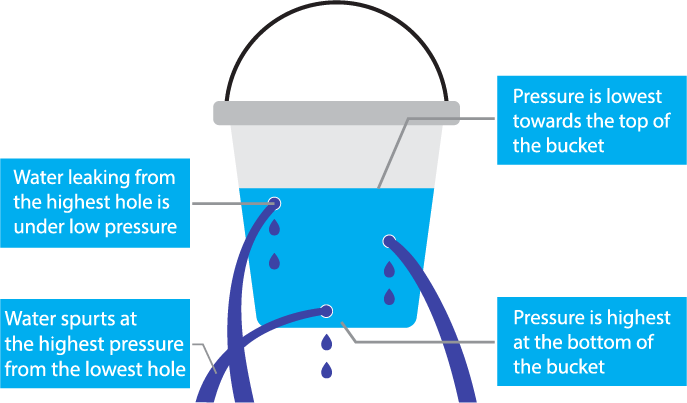
- The amount of pressure inside a body of liquid increases with depth.
- At greater depths, the weight of the liquid above is greater.
- Therefore, the pressure is greater.
Pressure in Liquids Formula
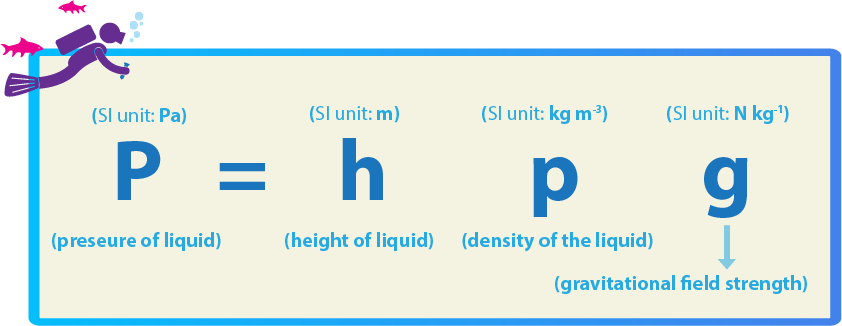
- From the equation p= hpg, we can see that the pressure in a liquid increases with the depth and density of the liquid.
- It does not depend on the volume or cross-sectional area of the liquid.
Classic Pressure in Liquid Questions
1. Explain why the height of the mercury in a barometer remains unchanged when the diameter of the inverted tube is changed.
- Since Pressure = (height of liquid column) x (density of liquid) x (gravitational field strength)
- then the height = pressure / [(density of liquid) x (gravitational field strength)].
- It means that the height of the mercury in the barometer depends only on the pressure and gravitational field strength.